

Fast Delivery
Quick, reliable shipping to any location.

Free & easy returns
Return this item by mail or in store within 90 days for a full refund.
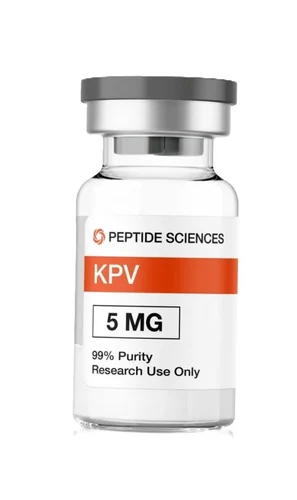
KPV Peptide: Research Profile of the Anti-Inflammatory Tripeptide
KPV (Lysine-Proline-Valine) is a synthetic tripeptide corresponding to the C-terminal fragment (amino acids 11-13) of alpha-melanocyte-stimulating hormone (α-MSH) . This small, stable peptide has been extensively studied as a research tool for its distinct anti-inflammatory and antimicrobial properties, mediated through mechanisms that appear independent of traditional melanocortin receptors .
What is KPV?
KPV is a bioactive tripeptide with the sequence Lys-Pro-Val, derived from the C-terminus of the larger neuropeptide α-MSH . Its simple, compact structure supports research into peptide stability, receptor-contact motifs, and enzymatic processing, making it a valuable tool for investigating peptide signaling and inflammation pathways at the molecular level .
Key Identifiers:
-
CAS Number: 67727-97-3
-
Synonyms: KPV Peptide (ACTH 11-13)
-
Sequence: Lys-Pro-Val
-
Source: C-terminal fragment of α-MSH
-
Purity: Typically ≥98% for research-grade material
-
Status: Research compound only; not FDA-approved for human use

Mechanism of Action
KPV exhibits anti-inflammatory effects through a mechanism that is clearly distinct from that of full-length α-MSH and other melanocortin peptides .
Independent of Melanocortin Receptors
Unlike α-MSH, which signals through melanocortin receptors (MC-R), research indicates that KPV is unlikely to mediate its effects through these receptors . Key findings include:
-
The anti-migratory effect of KPV was not blocked by the MC3/4-R antagonist SHU9119
-
KPV failed to increase cAMP accumulation in macrophages, a hallmark of MC-R activation
-
Anti-inflammatory effects were observed in mice with a nonfunctional MC1-R (recessive yellow e/e mice)
Inhibition of NF-κB Signaling
A significant body of research demonstrates KPV’s ability to suppress NF-κB signaling—a master regulator of inflammatory responses:
-
KPV evokes a dose-dependent inhibition of NF-κB, matrix metalloproteinase-9 activity, IL-8, and eotaxin secretion in human bronchial epithelial cells
-
The effect is associated with its nuclear import, IκBα stabilisation, and suppressed nuclear translocation of p65RelA
-
Competition assays reveal an interaction between KPV and the Imp-α3 binding site on p65RelA, suggesting blockade of nuclear import
Inhibition of IL-1β Functions
KPV’s anti-inflammatory properties are evident in IL-1β-induced inflammation models, suggesting the peptide may act through inhibition of IL-1β functions .
Antimicrobial Activity
KPV and its dimer have demonstrated direct antimicrobial effects:
-
Significant inhibition of Staphylococcus aureus and Candida albicans colony formation over a broad range of concentrations
-
Effective against Gram-negative bacteria such as E. coli and Pseudomonas aeruginosa
-
Antimicrobial effects are observed both in vitro and in rabbit models of peritoneal catheter infection
-
The peptide is noted for being less likely to generate resistant microbial strains and virtually non-toxic to mammalian cells
Research Applications
1. Anti-Inflammatory Research
KPV is a primary research tool for studying inflammation pathways, supported by over two decades of preclinical investigation. Key findings include:
-
Significant reduction (42%) in polymorphonuclear leukocyte migration in a mouse model of crystal-induced peritonitis (9 nmol dose; P < 0.05)
-
Inhibition of KC and IL-1β release in macrophage activation models
-
Anti-inflammatory effects observed in IL-1β-induced peritonitis models
-
Suppression of TNFα and RSV-evoked NF-κB signaling in bronchial epithelial cells
2. Antimicrobial Research
KPV and its dimer have demonstrated efficacy as antimicrobial agents:
-
Significant decrease in S. aureus and C. albicans colony forming units
-
Reduction of bacterial load in peritoneal catheter infection models in rabbits
-
Effective against Gram-positive (including S. epidermidis, responsible for 30-40% of PD infections, and S. aureus) and Gram-negative organisms
3. Host Defense Research
α-MSH and its fragment KPV are considered components of innate host defense in barrier organs such as skin and gut . Research suggests the peptide combines anti-inflammatory, antimicrobial, and potential antiviral effects .
Regulatory Status and Legal Considerations
| Aspect | Status |
|---|---|
| FDA Approval | Not FDA-approved for any indication |
| Clinical Status | Experimental; human trials limited |
| Evidence Base | Mostly preclinical (animal and cell culture studies) |
| Legal Status | Available for research purposes only |
Important Considerations
-
Evidence Limitations: Most data comes from preclinical animal and cell culture studies; human trials are limited
-
Safety Profile: Reported as well tolerated in research settings with low toxicity observed in models; long-term human safety is unknown
-
Route of Administration: Can be delivered topically, orally, or via injection in research models
Frequently Asked Questions
What is KPV peptide?
KPV is a synthetic tripeptide (Lys-Pro-Val) derived from the C-terminal fragment of α-MSH. It is studied for its distinct anti-inflammatory and antimicrobial properties .
How does KPV work?
KPV suppresses inflammation primarily through inhibition of NF-κB signaling and blockade of p65RelA nuclear import, rather than through classic melanocortin receptor signaling . It also demonstrates direct antimicrobial activity .
Is KPV FDA-approved?
No. KPV is not FDA-approved for any indication; all applications remain experimental .
What does research show about KPV?
Preclinical research demonstrates:
-
42% reduction in inflammatory cell migration in peritonitis models (P < 0.05)
-
Dose-dependent inhibition of NF-κB, IL-8, and eotaxin in airway epithelial cells
-
Significant antimicrobial activity against S. aureus, S. epidermidis, E. coli, and C. albicans
Is KPV safe?
KPV is reported as well tolerated in research settings with low toxicity observed in animal models. However, long-term safety in humans is unknown, and human trials remain limited .
Can I buy KPV for personal use?
KPV is available for research purposes only from authorized suppliers. It is not legally marketed for human therapeutic use .







Reviews
There are no reviews yet.