

Fast Delivery
Quick, reliable shipping to any location.

Free & easy returns
Return this item by mail or in store within 90 days for a full refund.
Hexarelin Acetate: Research Peptide Profile
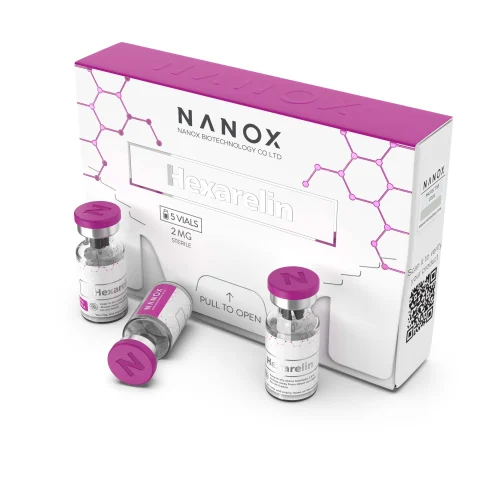
Hexarelin acetate (Examorelin) is a synthetic hexapeptide growth hormone secretagogue (GHS) and a super-analog of GHRP-6 . It is a potent agonist of the ghrelin/growth hormone secretagogue receptor (GHS-R1a) and also binds with high affinity to the non-GHSR receptor CD36 . Its structure, His-D-2-methyl-Trp-Ala-Trp-D-Phe-Lys-NH₂, incorporates a substituted 2-methyl-tryptophan residue that confers enhanced chemical stability and resistance to proteolytic degradation compared to endogenous ghrelin and other GHRPs .
Mechanism of Action
Hexarelin functions through several well-characterized pathways:
GHS-R1a Binding:
-
Hexarelin is a potent agonist of the growth hormone secretagogue receptor type 1a (GHS-R1a), which is also the receptor for ghrelin .
-
It demonstrates high-affinity binding to the human GHS-R1a with an IC₅₀ of approximately 6-16 nM .
-
Upon binding, it activates intracellular signaling cascades involving phospholipase C and protein kinase C, stimulating the secretion of growth hormone from somatotrophs in the anterior pituitary gland .
GH Release:
-
Hexarelin stimulates growth hormone release in a dose-dependent manner. In a rat model, the peak plasma GH response to a 25 µg/kg i.v. bolus of Hexarelin was 552 ± 125 ng/ml, compared to 386 ± 132 ng/ml for GHRP-6 under identical conditions—an approximately 43% higher peak response .
-
In human subjects, a 1 µg/kg i.v. dose induced a GH response with an AUC₀₋₁₈₀ of 2.918 µg·min·ml⁻¹, demonstrating a nearly 3.7-fold greater effect than GHRH at the same dose .
-
Hexarelin suppresses the action of somatostatin (growth hormone-inhibiting hormone), further escalating GH production .
CD36 Receptor Binding:
-
Hexarelin uniquely activates myocardial CD36 receptors (IC₅₀ of 42.7 µM), providing a selective probe for cardioprotection research that is not shared by GHRP-6 or GHRP-2 .
-
This CD36-mediated action contributes to GH-independent positive inotropic effects on the heart, validated in GH-deficient models .
Key Research Applications
Cardioprotective and Inotropic Research
Hexarelin is a distinct research tool for investigating GH-independent, cardioprotective mechanisms. A clinical study showed that acute administration of 2.0 μg/kg IV hexarelin significantly increased Left Ventricular Ejection Fraction (LVEF) in both normal subjects and patients with severe growth hormone deficiency, despite no significant GH release in the GHD group (p < 0.05) . This provides direct evidence for a GH-independent mechanism of action on the heart.
In a rat model of chronic heart failure, GHRP treatment (including hexarelin, 100 µg/kg, SC twice daily for 3 weeks) significantly improved left ventricular function and remodeling, as indicated by:
-
Increased LV ejection fraction, LV end-systolic pressure, and diastolic posterior wall thickness
-
Decreased LV end-diastolic pressure and LV end-diastolic dimension
-
Significant alleviation of cardiac cachexia, with increases in body weight and tibial length
The treatment also suppressed cardiomyocyte apoptosis and decreased plasma levels of stress-related hormones (catecholamines, renin, angiotensin II, aldosterone, endothelin-1, and atrial natriuretic peptide) .
Endocrine and Growth Hormone Research
For experiments focused on the GHS-R1a receptor, Hexarelin serves as a well-characterized, high-affinity agonist . Its enhanced proteolytic stability supports longitudinal protocols for studying GH secretion and regulation .
Comparative Pharmacology
Hexarelin’s unique dual-receptor pharmacology (GHS-R1a and CD36) distinguishes it from other GHRPs. It demonstrates superior GH-releasing potency to GHRP-6 . Unlike Ipamorelin, which has a distinct, highly selective profile with minimal prolactin or cortisol release, Hexarelin has been shown to have effects on the pituitary-adrenal axis—though chronic administration studies demonstrate that over-stimulation of cortisol and prolactin does not occur with appropriate dosing .
Safety Profile and Considerations
Pituitary-Adrenal Axis Effects
A 16-week clinical study of twice-daily subcutaneous hexarelin therapy (1.5 µg/kg) assessed the impact on the pituitary-adrenal axis and serum prolactin levels. Results demonstrated:
-
No significant changes in urinary free cortisol, basal cortisol, ACTH area under the curve, or cortisol binding globulin over the study period .
-
No significant change in prolactin AUC over the study period .
-
The study concluded that over-stimulation of the pituitary-adrenal axis and prolactin secretion do not occur with this dosage regimen .
General Safety Considerations
Reported side effects may include joint pain, water retention, and receptor desensitization with prolonged use . The peptide’s high potency (ED₅₀ ~0.48 µg/kg) means dose estimation errors carry consequences .
Regulatory Status
-
FDA Status: Not FDA-approved for any indication.
-
Canada: Health Canada has issued safety alerts regarding unauthorized injectable hexarelin products, noting they have not been assessed for safety, efficacy, and quality .
-
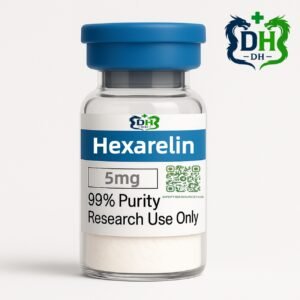
Research-Use Only: Hexarelin is available from research suppliers for laboratory use only and is not for human consumption .
Reconstitution & Handling for Research
General Handling:
-
Molecular Formula: C₄₇H₅₈N₁₂O₆
-
Molecular Weight: 887.0 g/mol
-
Sequence: His-D-2-Me-Trp-Ala-Trp-D-Phe-Lys-NH₂
-
Purity: Typically ≥98% for research-grade material
-
Storage: Store lyophilized powder at -20°C, protected from light
-
Solubility: Soluble in water
-
Bioavailability (SC): 64% in rats; half-life: 75.9 minutes
Frequently Asked Questions
What is Hexarelin Acetate?
Hexarelin acetate is a synthetic hexapeptide and a super-analog of GHRP-6 that acts as a potent agonist of the ghrelin/GHS-R1a receptor .
How does Hexarelin Acetate work?
It binds to GHS-R1a in the pituitary and hypothalamus, stimulating GH release through calcium influx and other signaling pathways. It also uniquely activates CD36 receptors in the heart, mediating cardioprotective effects .
Is Hexarelin FDA-approved?
No. Hexarelin is not FDA-approved for any indication. It is a research compound available exclusively for laboratory use .
What does research show about Hexarelin?
Research demonstrates superior GH-releasing potency compared to GHRP-6, cardioprotective effects (including improved LVEF in GH-deficient patients), and benefits in chronic heart failure models .
How does Hexarelin differ from other GHRPs?
Hexarelin has a unique 2-methyl-tryptophan modification providing enhanced stability, superior GH-releasing potency, and a unique CD36-mediated cardioprotective effect not shared by GHRP-6 or GHRP-2 .
Is Hexarelin banned in sports?
Hexarelin would be prohibited under WADA regulations as a peptide hormone and growth factor modulator.
Can I buy Hexarelin?
Hexarelin is available from research suppliers for laboratory use only. It is not legally marketed for human consumption .







Reviews
There are no reviews yet.