

Fast Delivery
Quick, reliable shipping to any location.

Free & easy returns
Return this item by mail or in store within 90 days for a full refund.
Melanotan 1 – Product Description
The Original α-MSH Analog for Photoprotection and Pigmentation Research
Melanotan 1 (MT-I), also known as afamelanotide, is a synthetic analog of the naturally occurring α-melanocyte-stimulating hormone (α-MSH) . As a potent, non-selective melanocortin receptor (MCR) agonist, it stimulates melanocytes to increase melanin production, providing a protective effect against ultraviolet radiation (UVR)-induced skin damage . This synthetic peptide is one of the foundational compounds in pigmentation research and has been clinically developed as a photoprotective agent for conditions like erythropoietic protoporphyria (EPP) .
Table of Contents
-
What is Melanotan 1?
-
Mechanism of Action
-
Key Research Findings
-
Dosing and Administration
-
Safety Profile
-
Frequently Asked Questions (FAQs)
-
References
What is Melanotan 1?
Melanotan 1 is a synthetic 13-amino acid peptide analog of α-MSH with the sequence Ac-Ser-Tyr-Ser-Nle-Glu-His-D-Phe-Arg-Trp-Gly-Lys-Pro-Val-NH₂ . It incorporates two key modifications from the native hormone: norleucine substitution at position 4 and D-phenylalanine at position 7, which enhance its potency and stability .
| Property | Detail |
|---|---|
| Synonyms | Afamelanotide, MT-I, [Nle⁴,D-Phe⁷]-α-MSH, NDP-MSH |
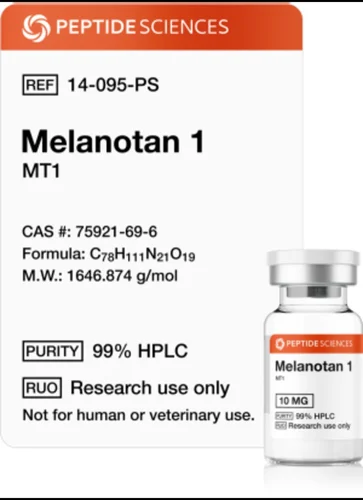
| CAS Number | 75921-69-6 |
| Molecular Formula | C₇₈H₁₁₁N₂₁O₁₉ |
| Molecular Weight | 1646.85 Da |
| Sequence | Ac-Ser-Tyr-Ser-Nle-Glu-His-D-Phe-Arg-Trp-Gly-Lys-Pro-Val-NH₂ |
| Active Core | His-Phe-Arg-Trp (identical to endogenous α-MSH) |
Mechanism of Action
Melanotan 1 functions primarily through agonism of the melanocortin 1 receptor (MC1-R) on melanocytes :
| Mechanism | What It Does | Why It Matters |
|---|---|---|
| MC1-R Activation | Mimics endogenous α-MSH, binding to MC1 receptors on melanocytes | Triggers the melanin production cascade |
| Melanin Synthesis | Stimulates production and release of eumelanin (brown/black pigment) | Provides photoprotection through skin darkening |
| UVR Protection | Increases melanin levels that may protect against UVR-initiated DNA damage and oxidation | Reduces cellular damage from sun exposure |
| Synergistic Tanning | Acts synergistically with UV-B light or sunlight to enhance tanning response | Allows for lower UV exposure for equivalent pigmentation |
The active site responsible for melanocortin activity is the conserved sequence His-Phe-Arg-Trp, which is shared with the endogenous hormone and other melanocortin peptides .
Key Research Findings
Clinical Safety and Efficacy (Phase 1)
Three phase 1 clinical trials demonstrated that Melanotan 1 can be safely combined with UV-B light or sunlight and acts synergistically in the tanning response :
-
10-day trial (0.08 mg/kg): 3 of 4 subjects achieved tanning with 47% fewer sunburn cells at irradiated sites
-
Higher dose (0.16 mg/kg): More skin sites darkened with enhanced effect
-
Sunlight study: MT-I group showed significantly enhanced tanning maintained at least 3 weeks longer than controls, who required 50% more sun-exposure time for equivalent tanning
-
Toxic effects: Minor, consisting of nausea and transient facial flushing
Sustained Pigmentation
Controlled-release implants containing 4 mg Melanotan 1 demonstrated prolonged skin darkening for up to three months in animal models, with a 2.5-fold increase in eumelanin levels observed after one month .
FDA-Approved Indication
Afamelanotide (Melanotan 1) is FDA-approved as SCENESSE for increasing pain-free light exposure in adult patients with erythropoietic protoporphyria (EPP), a condition causing severe phototoxic reactions . It is administered as a 16 mg subcutaneous implant every 2 months .
Dosing and Administration
| Formulation | Dose | Frequency | Administration |
|---|---|---|---|
| Clinical research (injection) | 0.08–0.16 mg/kg | Daily for up to 10 days | Subcutaneous |
| FDA-approved (implant) | 16 mg | Every 2 months | Subcutaneous implant |
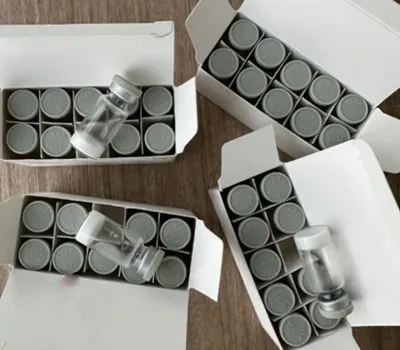
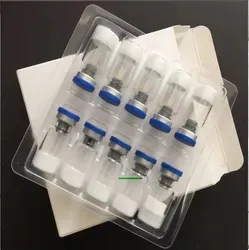
| Research peptide (lyophilized) | Varies | Per study protocol | Reconstituted for injection |
Storage Guidelines — Lyophilized peptide should be stored in a freezer at or below -20°C. Reconstituted solution can be stored at -20°C for up to six months .
Safety Profile
Melanotan 1 is generally well-tolerated in clinical research settings, with adverse effects typically being mild .
Common Adverse Reactions
-
Nausea (most frequently reported)
-
Transient facial flushing
-
Implant site reaction (for SCENESSE)
-
Skin hyperpigmentation (expected pharmacological effect)
-
Fatigue, dizziness, somnolence (SCENESSE)
Important Safety Considerations
-
Skin Monitoring: Regular full-body skin examinations are recommended due to potential darkening of pre-existing nevi and ephelides
-
Hypersensitivity: Serious reactions including anaphylaxis have been reported; SCENESSE is contraindicated in patients with known hypersensitivity
-
Dysplastic Nevi: Melanotan I has been associated with activation of dysplastic nevi

Frequently Asked Questions (FAQs)
1. What is the difference between Melanotan 1 and Melanotan 2?
Melanotan 1 (afamelanotide) is primarily a photoprotective agent that stimulates melanin production. Melanotan 2 is a cyclic analog that also affects melanocortin receptors but has additional effects, including on erectile function . They have distinct amino acid sequences and receptor binding profiles.
2. Is Melanotan 1 FDA-approved?
Yes. Afamelanotide (Melanotan 1) is FDA-approved as SCENESSE for the treatment of erythropoietic protoporphyria (EPP) . It is not approved for cosmetic tanning purposes.
3. What is the mechanism of action?
Melanotan 1 binds to melanocortin 1 receptors (MC1-R) on melanocytes, mimicking the action of endogenous α-MSH. This stimulates the production and release of melanin, which provides photoprotection against UV radiation .
4. How is Melanotan 1 administered?
In clinical research, it is typically administered via subcutaneous injection daily for a defined period. The FDA-approved formulation (SCENESSE) is a subcutaneous implant containing 16 mg of afamelanotide, administered every 2 months by a healthcare professional .
5. What are the side effects?
Common side effects include nausea, transient facial flushing, and injection/implant site reactions . Skin hyperpigmentation is an expected effect. Regular skin monitoring is recommended due to the potential for darkening of existing moles .
6. Does Melanotan 1 have antioxidant properties?
Yes. By increasing melanin production, it may protect against UVR-initiated cellular DNA damage and oxidation of membrane proteins . However, it is not studied as a systemic antioxidant.
7. Is Melanotan 1 used for male erectile dysfunction research?
While Melanotan 1 has been noted in research related to melanoma and male erectile dysfunction , this is more prominently associated with Melanotan 2, which has been studied for its effects on penile erection via central and peripheral melanocortin pathways .
References
-
DrugFuture. Melanotan – CAS Registry Information
-
BioPortal / NCI Thesaurus. Afamelanotide (Melanotan I) – Definition and Properties
-
FDA DailyMed. SCENESSE (afamelanotide) – Prescribing Information. 2024
-
NovoPro Bioscience. Melanotan I Peptide – Product Specifications
-
TargetMol. Melanotan I – Product Information
-
PubMed. Phase 1 Clinical Trials of Melanotan-1. J Invest Dermatol. 2005
-
BOC Sciences. Melanotan I – Product Information and References
-
PubMed. Pharmacologic Response of Controlled-Release PLGA Formulation for Melanotan-I. Pharm Res. 2000





Reviews
There are no reviews yet.